

Two baptisms in Madagascar

Justin Renton • November 11, 2019
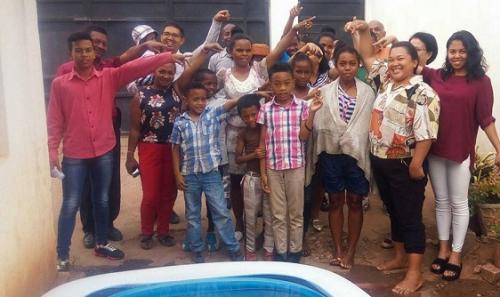
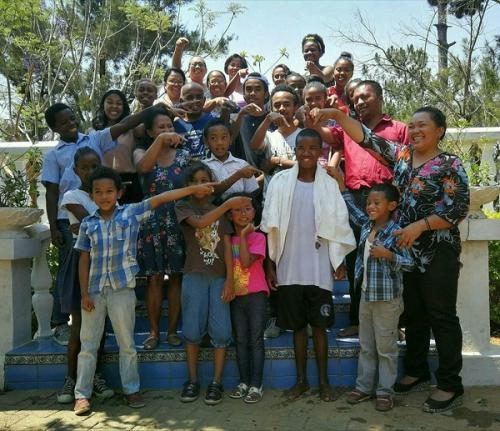
The disciples in the small church of Antananarivo, Madagascar, recently had double cause for celebration with the baptisms of two young people. This brings the total number of members to 24.
Abdo was baptised at the end of October, and is a teenager who started playing soccer with some of the teen boys in the church. Blown away by the love of the congregation, he started studying the Bible and was added to their number.

Having lost both his parents, Abdo currently lives with his grandmother, and one of the sisters in the church is sponsoring his education.


"The disciples are so inspired by Abdo and his great love for the scriptures, and also because they can see how the church provided hope in his life," says Roma Randrianavelona who, together with his wife Hanta, lead the group on a voluntary basis. 

Stéphanie is the daughter of Falli, who was restored to the fellowship in 2018, and her mother is currently in the process of being restored.

Stéphanie will join the campus ministry in December.
There are no full-time leaders in the church, yet the disciples are faithful and keep on trusting God to help them raise families who love the scriptures and the people around them.
Did you know that Madagascar is the fourth largest island in the world and is thought to have broken off from the Indian sub-continent 85 million years ago? Around 90% of its plants and animals are found nowhere else in the world, and you can find both the biggest and smallest chameleons in the world right on their doorstep. Up until 1897, Madagascar was ruled by royal families until they were annexed as a French colony. And although they are independent today, the Malagasy people are among the poorest in the world, with many people living on $2 a day.

But why don't you go and see it for yourself? The disciples welcome visitors to their fellowship with open arms. And they are keen to point out there's so much more to their city and country than "King Julius" created for the Hollywood movie named after their beautiful island.

More from Southern African Churches of Christ

By Justin Renton • October 5, 2026
Imagine you are at a neighborhood barbecue. Your new neighbor arrives late, dressed casually, and barely speaks. Someone whispers, “She thinks she’s too good for us.” You feel the quick sting of that snap judgment. Later, you learn she just lost her husband and is quietly grieving. In that moment, you sense the discomfort of judging wrongly, a rush to conclusions that harms relationships and reveals more about our own hearts than the other person. Yet, the same evening, when another guest makes a racist joke, you feel an inner nudge to speak up. Is that also “judging”? This everyday tension captures what Jesus presents in Scripture: a divine balance between grace-filled restraint and righteous discernment. The two commands in tension “Do not judge, or you too will be judged.” – Matthew 7: “Stop judging by mere appearances, but instead judge correctly.” – John 7:24 At first glance, these seem contradictory. Don’t judge. Judge correctly. Which is it? Matthew 7 warns against a critical, hypocritical spirit that condemns others while ignoring our own faults. The context continues: “For in the same way you judge others, you will be judged, and with the measure you use, it will be measured to you” (Matthew 7:2). Jesus then uses the vivid image of someone with a plank in their own eye trying to remove a speck from another’s. Notice the aim: “then you will see clearly to remove the speck.” Self-examination is not a reason to stay silent. It is how we become safe enough to speak (Matthew 7:3-5). John 7, however, shows Jesus defending his healing on the Sabbath. He challenges the religious leaders: stop superficial, appearance-based judgments and instead apply right, truthful judgment aligned with God’s character and Word. This is not a contradiction but a divine tension, two truths that must be held together. We are called to humility and self-examination (do not judge harshly or hypocritically), while also exercising discernment and moral clarity (judge correctly, according to truth). Christianity rejects both naive permissiveness (“anything goes, no one can say anything”) and harsh legalism (constant condemnation without grace).
DT Travel Climbs Mt. Kilimanjaro: FAQ’s
By DT Travel • October 1, 2026
Here are answers to some frequently asked questions about next year’s trip to Mt. Kilimanjaro.
By Justin Renton • September 2, 2026
The physics of the pendulum Picture an old grandfather clock in a quiet hallway. Its long brass pendulum swings steadily: tick, tock, tick, tock. Now give that pendulum a hard shove to the right. It does not simply glide back to the center and stop. It races right past the middle and sways just as far to the left. Left to its own momentum, a pendulum never rests at either extreme; it finds peace only when it hangs still at the center, held by gravity and its fixed point. The church behaves in much the same way. Push her too far toward one side of a truth and she does not gently settle into balance, she swings. Often for a whole generation toward the opposite error, and then back again, wounding people at both ends of the arc. And here is the crucial thing the clock teaches us: the pendulum comes to rest not by being frozen in place, but by being held. Balance is not the absence of force; it is the fixed point that keeps opposing pulls in tension so that the weight can finally hang still.
Show More